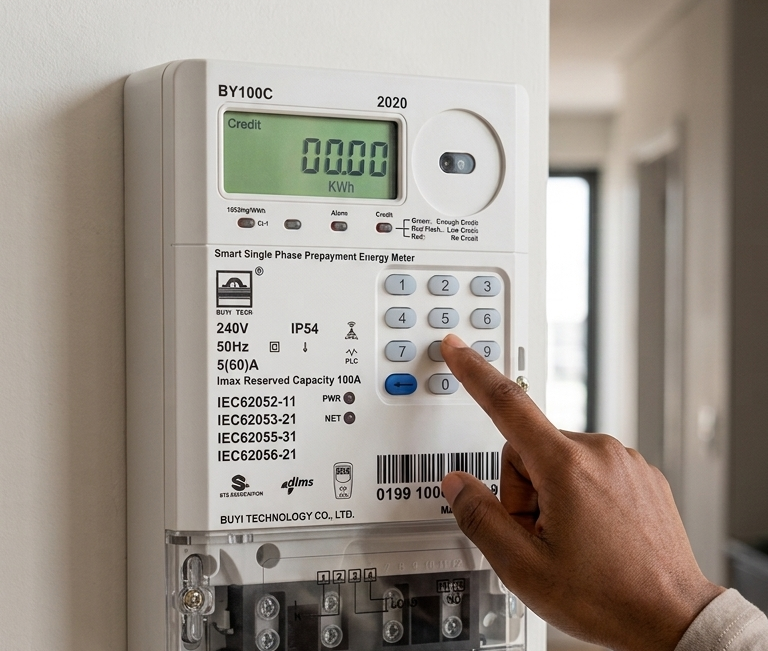
A plain-English guide to the LED indications on the Brainsfield BY100C and BY300C
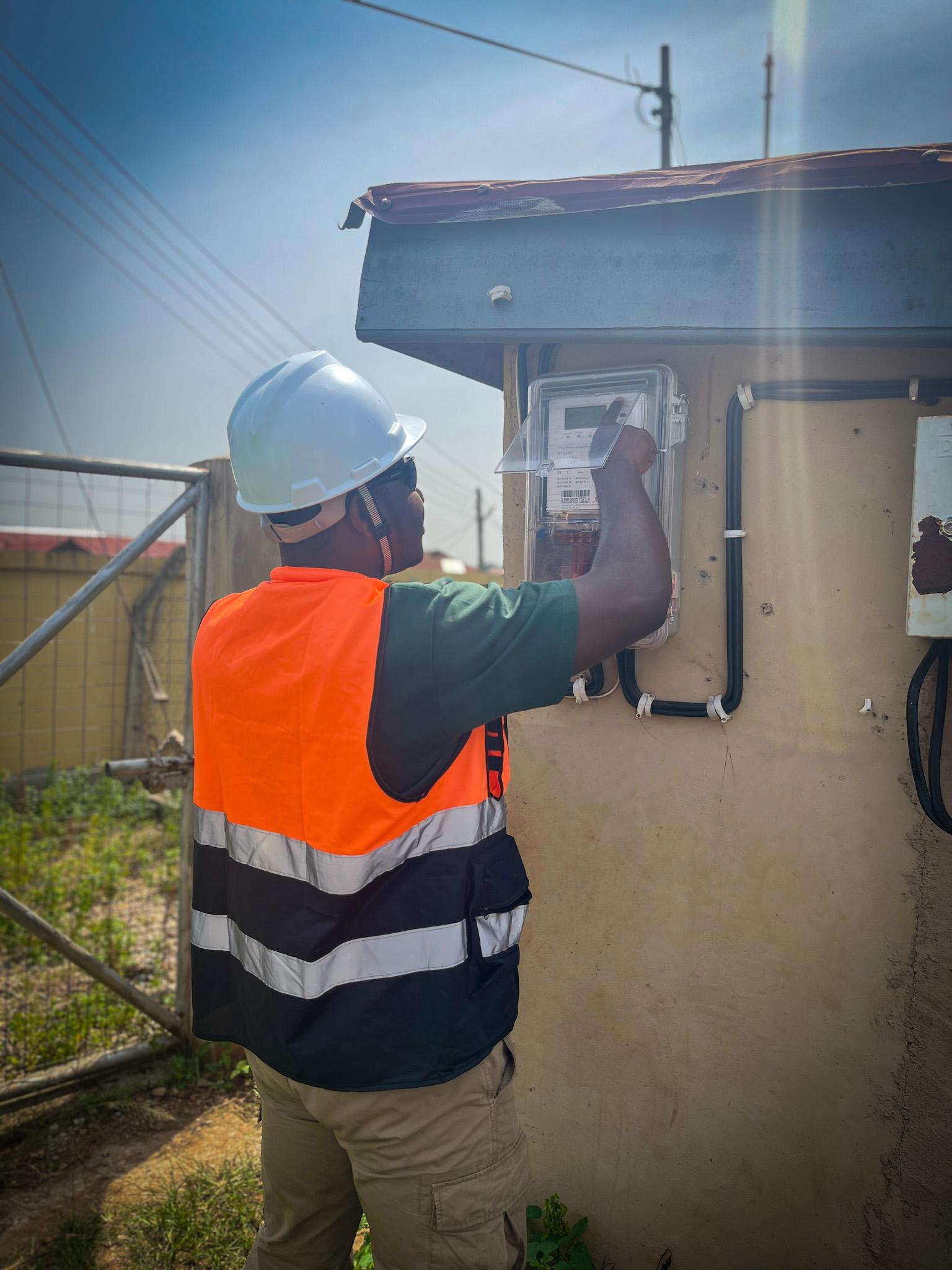
So you have been issued a Brainsfield Smart Prepaid Meter by the Electricity Company of Ghana, and now there is a light blinking at you and nobody has explained what it means.
You are not alone in this. Somebody’s uncle will tell you the meter is spoiled. Somebody’s neighbour will tell you disconnection is coming. Somebody will suggest hitting it. Very few people will simply tell you what the light means.
Here is what it means. Your meter is not misbehaving; it is communicating. Those LEDs are the only vocabulary it has, and there are fewer words in it than you think. Learn them once and the anxiety disappears entirely.
First, know which light you are looking at…
The meter carries three LEDs, each with a separate job. Half the confusion I encounter comes from people watching the wrong light and drawing conclusions from it.
- The Pulse LED tells you about consumption.
- The Alarm LED tells you about faults, disconnection and tampering.
- The Credit LED tells you about money.
There is also a buzzer. Let us take them one at a time.
The Pulse LED: the meter’s heartbeat
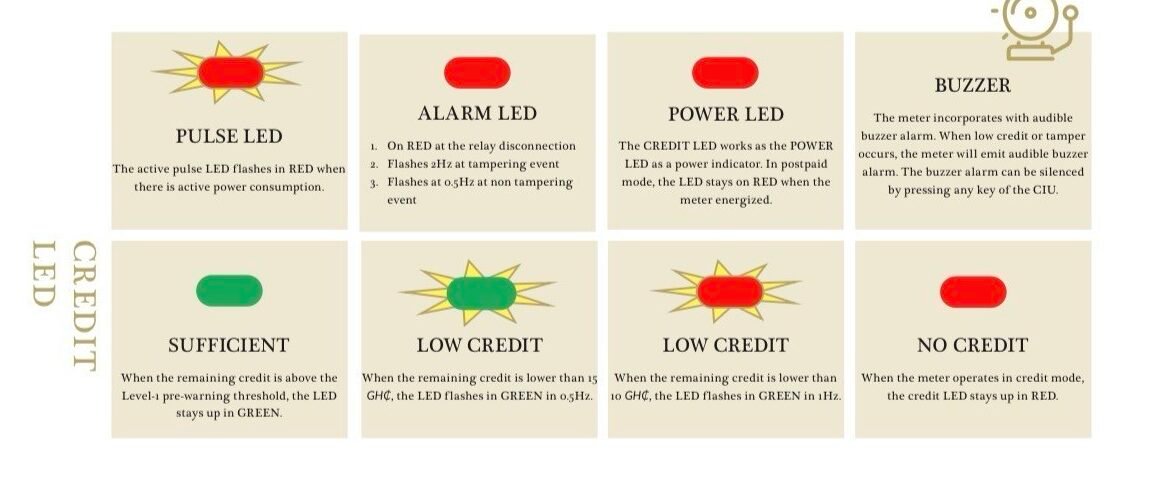
Red, flashing during active power consumption.
This is the light that worries people most and deserves it least. It flashes red whenever power is actively being consumed in the premises. That is its entire function. If it is flashing, electricity is flowing.
There is one genuinely useful thing you can do with it. Switch off everything in the house; every bulb, every socket, the fridge, the fans. Then go and watch the Pulse LED. If it keeps flashing steadily with nothing switched on, something is still drawing power. Worth investigating.
Beyond that, a flashing Pulse LED is not a warning of anything.
The Alarm LED: the one worth paying attention to.
This LED has three things to tell you, and the difference between them is entirely in the rhythm. Slow down and count.
- Steady red, not flashing: The relay has disconnected. Supply has been cut at the meter.
- Fast flash, twice a second (2Hz): A tampering event has been registered. The meter believes someone has interfered with it.
- Slow flash, once every two seconds (0.5Hz): A non-tampering event has been registered. Something is flagged, but the meter does not consider it interference.
Let me put it plainly: fast means tamper, slow means fault. Twice a second is an accusation. Once every two seconds is a report.
If you see the fast 2Hz flash and you know nobody has touched the meter, do not ignore it and do not try to clear it yourself. Tamper events are logged by the system. Report it and have it inspected, because a tamper flag that sits unexplained for months becomes a far harder conversation than one reported the same week.
The Credit LED: theit’s all about the money one that costs you money
This is where a little attention translates directly into never being caught in darkness at an inconvenient hour.
- Steady green: Credit is above the Level-1 pre-warning threshold1. Nothing to do.
- Flashing green, once every two seconds (0.5Hz): Credit has fallen below GH₵15. First warning. Top up when convenient.
- Flashing green, once every second (1Hz): Credit has fallen below GH₵10. Second warning. The meter has doubled its pace to get your attention. Treat it as a same-day task.
- Steady red: No credit remaining. At this point disconnection is not a threat, it is the current state of affairs.
The design logic is rather elegant. Green means money; the faster it flashes, the less of it there is. Red means the money is finished. The meter escalates the way a reasonable person would: a gentle mention, then a firmer one, then silence and consequences.
So the advice writes itself. Top up at the first flash, not the second. The gap between GH₵15 and GH₵10 exists precisely so you have a comfortable window in which to act.
The Buzzer: when the meter stops being polite
The meter also carries an audible buzzer alarm. It sounds on low credit and on tamper events, the same two conditions the lights are already reporting, escalated to sound because a light in an unwatched corridor communicates nothing at all.
It can be silenced by pressing any key on the CIU.
I know exactly how that sentence will be used, so let me add the obvious. Silencing the buzzer resolves nothing. The buzzer is the symptom; the low credit or the tamper flag is the condition. Press the key to restore peace in your house, then go and deal with the actual issue. Silence is not a solution, it is an agreement between yourself and the meter that “I’m aware”.
If your meter is doing this right now …
This is the TL;DR section, you know; for my people.
Everything above is organised by light, which assumes you already know which light you are looking at. Most people don’t. So here is the same information arranged the way the problem actually arrives.
It is beeping and I want it to stop: Press any key on the CIU. That silences it. Then check your credit, because the buzzer only sounds for two reasons: low credit or a tamper event.
A green light has started blinking: Your credit is running low. Blinking once every two seconds means you are below GH₵15. Once every second means you are below GH₵10 and should top up today.
A red light is flashing fast and will not stop: Count the rhythm. Twice a second is a tamper flag on the Alarm LED. Report it to your service provider and do not attempt to clear it yourself.
A red light is flashing slowly, about once every two seconds: That is a non-tampering event. Something has been flagged for a technician to look at. Report it, but there is no need to lose sleep over it.
A red light is on steadily and I have no power: The relay has disconnected and supply has been cut at the meter. If your credit is also finished, that is your answer. Top up.
A red light keeps flickering but everything is working fine: That is almost certainly the Pulse LED doing its job. It flashes whenever power is being consumed. Nothing is wrong.
If you take away only one line from all of this, take this one: fast means tamper, slow means fault, green means money, red means it is finished.
Learn the lights. Top up at the first flash. Report tamper flags the week they appear, not the month you are questioned about them.